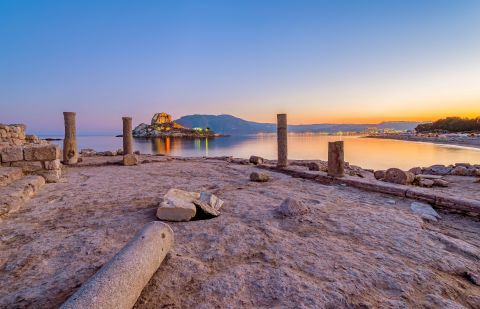
Saint John is one of the very few Christian baptisteries that have remained almost intact.
Today, it is used as a cemetery church, and houses fine frescoes dating back to the 12th and 13th century, depicting scenes of the life of Saint John the Precursor.
Interesting architectural elements can be observed in the church, such as the use of a Hellenistic frieze on the lower part of the sanctuary apse and the existence of architraves, pilasters and capitals in various parts of the walls.
| The
Church of Agia Paraskevi |
|
This huge church is located in the capital of Kos, dominating the heart of the town.
It is beautifully painted with beige and blue and its interior is richly decorated.
On its feast day, many pilgrims
|
 |
narthex on its western part.
Two entrances are giving to the narthex and lead westwards to an atrium that stands on a lower level and gives access to two large stairs.
Some annexes with apses are located along the southern side of the basilica.
The interior of the basilica is richly decorated and houses some fine mosaics and sculptures.
The northern Basilica is smaller and has three aisles, columns and pillars. A rectangular narthex stands on its western side.
| The
Monastery of Agios Ioannis |
|
The monastery of Agios Ioannis (Saint John) is located 7 kilometres south of the picturesque settlement of Kefalos.
Plane trees and a paradise-like setting surround it. |
 |
The feast day of the monastery is celebrated on the 29th of August, a celebration during which the inhabitants of Kos come to pay their respect to Saint John.
The beautiful Byzantine church of Ipapandi stands within the ruined walls of a Byzantine fortress, in the village of Pyli, west of Kos Town.
Its walls are beautifully decorated with superb 14th century icons and frescoes.
The church houses a wonderful marble altar standing on four pillars.
From the site of this church visitors can enjoy a breathtaking view over the neighbouring islands of Kalymnos and Pserimos.
The feast day of Ipapandi is celebrated on the 2nd of February.
|