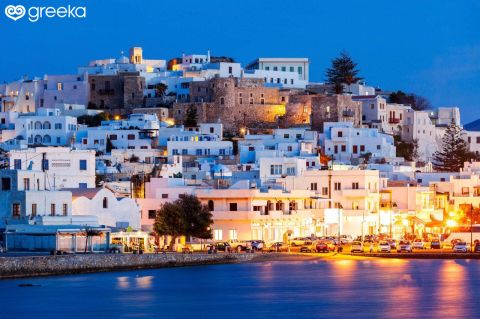
Naxos is the largest island in the Cyclades, renowned for its rich history and beautiful architecture. According to mythology, Zeus, the king of Olympian gods, grew up in Naxos, hidden away from the ferocity of his father, Cronus. Dionysus, the god of wine, loved Naxos so much that he made its land fertile, full of vineyards, producing wine of excellent taste and high quality. The locals then built a temple to Dionysus to honor their god.
Naxos is also the place where Theseus took Ariadne, who helped him find his way in the labyrinth where the Minotaur lived. There, he left Ariadne (or Ariadne left him, depending on the version of the legend), with whom Dionysus fell madly in love. The god took the young girl to Mount Drios and, from their union, Oinopion (Wine Drinker), Staphylos (Grape), and Evanthi (Lovely Flower) were born.
Ancient times
Historically, Naxos was the most important center of civilization of all the Cyclades during the ancient period (4000-1000 BC). The Thracians were the first inhabitants of Naxos who stayed for two centuries until the Carians took control of the island.
It is believed that the island owes its name to its leader of Thracians called Naxos. After that, the land was dominated by the Ionians. They contributed to the development and growth of Naxos with sea trading, which brought wealth during the 7th century BC. Prelude to the Persian war, the Naxos revolt encouraged other cities to join the fight against the Persians.
During the third quarter of the 6th century BC, tyrant Lygdamis ruled Naxos. He wanted to build several structures on the island and, during his rule, the most impressive historical attractions of Naxos were built - the Temple of Demeter and the Portara of Naxos. In fact, Portara is the lintel of a temple that would be dedicated to Apollo but was never completed.
Then the Peloponnesian War came, during which the Athenians lost to the Spartans, who took control of the island.
Afterward, Naxos fell under a succession of authorities - the Macedonian Empire, the Ptolemy of Egypt, the Rhodians, and, in 41 BC, the Roman Empire. Christianity appeared on the island during the 1st century AD.
Venetian period
The Venetians marked the history of Naxos. In 1207, Marco Sanudo took the Cyclades and established a duchy called the Duchy of the Aegean, where Naxos was the headquarters. The new ruler was designated, creating the beginning of a long line of Dukes in Naxos. The first reaction of the inhabitants of Naxos was negative, but they were obliged to admit their defeat.
During those years, Marco Sanudo divided the island into 56 provinces, distributed them among various Venetian nobles, and built a beautiful and powerful castle on top of Naxos Town.
The Ursulines School and Merchant Academy were also founded inside the castle. The power of Marco Sanudo lasted until 1564 when the Turks took entire Greece.
During the Turkish Ottoman rule, Naxos had a privileged place for the Venetians to negotiate to keep their authority and monarchic administration. The Turks were never established on the island and the only thing there were demanding was to receive their taxes in time. The island of Naxos became part of the liberated New Greek State in 1831.
We use cookies to offer you a better browsing experience and to analyze site traffic. By browsing this site you agree to our use of cookies. Learn more about our cookies policy