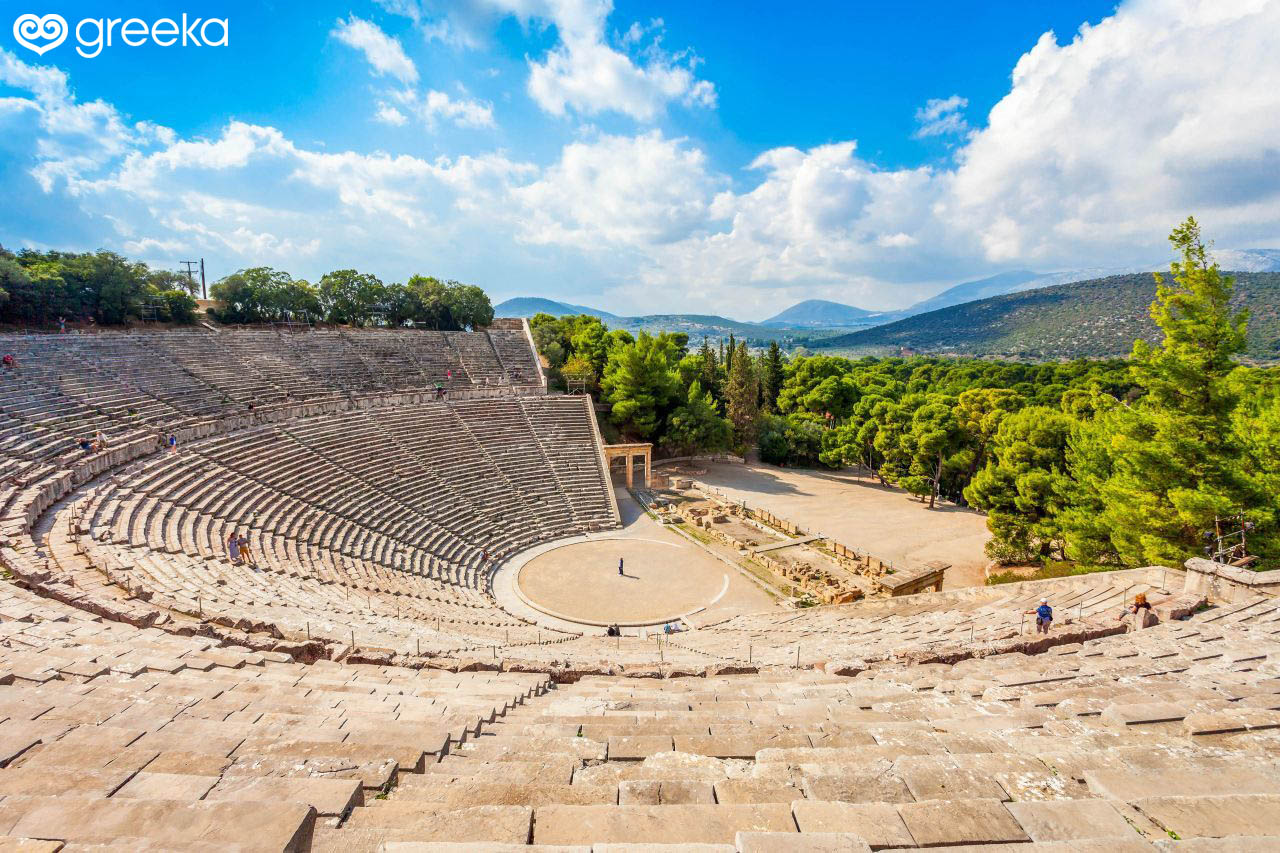
Epidaurus became known in the entire ancient Greek world for the holy sanctuary of Asklepios, which was considered the most marvelous of all sanctuaries in Greece. Beautifully surrounded by the verdant landscape, the ancient theatre of Epidaurus is one of the best-preserved monuments in the world, and the finest example of ancient Greek architecture, dedicated to Asklepios. It was built during the late 4th century by Polykleitos, on the slopes of Mount Kynortion. This structure, including an auditorium, orchestra, and stage, is characteristic of the Hellenistic period theaters. It consists of two sections separated by a semi-circular aisle: the lower section has 34 rows of benches and the upper section which was added later has 21.
The theatre of Epidaurus dedicated to the God of healing had huge extent and is known for its great acoustics, even to this day. In contrary to other ancient theatres in Greece, the theatre of Epidaurus did not change its form during the Roman years, thus it retained its authentic form until the end of the antiquity. The visitor will be amazed by the wondering monuments and sights in the archaeological site of Epidaurus.
However, the architecture of Epidaurus is not restricted in the ancient site. In close distance lays Nea Epidaurus, a picturesque settlement which is built on the hill slopes of a steep gorge, under the ruins of the Venetian castle. There you will see a nice collection of tiled roof houses but in order to access the top of the hill, you will pass through many colorful yards. Of great interest is the church of Agios Ioannis and Agnoundos Monastery.
We use cookies to offer you a better browsing experience and to analyze site traffic. By browsing this site you agree to our use of cookies. Learn more about our cookies policy