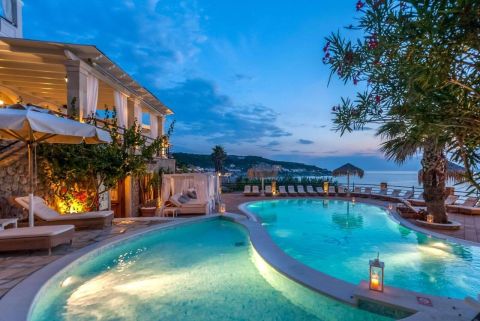
Corfu was one of the first islands in Greece to become well-known to foreign visitors. The island attracts thousands of holidaymakers from across the world every year.
It is part of the Ionian Islands and lies in the north region of the group, at the entrance of the Adriatic Sea facing Albania.
Corfu has a total area of 592 sq km and a coastline of 216 km, making it the second-largest island of the Ionian group after Kefalonia.
Because of the mild Mediterranean climate and the frequent rainfalls during winter, Corfu is full of verdant vegetation and wild plants and is considered one of the greenest islands in Greece. The island is mountainous and in its northern center lays Mount Pantokrator, the highest mountain of Corfu, which rises to an altitude of 914 m. Several flat areas, plains, two lakes and a couple of rivers top off the beautiful landscape.
Thanks to its popularity among tourists for decades now, Corfu offers well-equipped and modern tourist facilities. Even though tourism is developed in the coastal areas, it hasn't spoilt the villages yet as they have preserved their authenticity and local colors.
The economy of Corfu is mainly based on tourism but a small part is still related to agriculture; some inhabitants still produce high-quality olive oil and wines throughout the mountainous villages.
The capital and main port of the island is Corfu Town. It is the largest town of the Ionian and one of the most beautiful Greek towns overall. Built between two fortresses and full of astonishing Italian and French buildings, Byzantine churches and florescent squares, Corfu Town is a real jewel full of charms and beauties.
Corfu's natural beauty hasn't gone unnoticed by the film industry. In fact, the island has been the setting for several movies. On the north of Corfu, there are three small islands, untouched by tourism and great for total privacy: Othoni, Mathraki, and Ereikoussa, alternatively called the Diapontia Islands. They can be reached by boat from Agios Stefanos or Sidari.
We use cookies to offer you a better browsing experience and to analyze site traffic. By browsing this site you agree to our use of cookies. Learn more about our cookies policy