separated in between them by 3 kilometres.
The monastery stands by a bridge over the Kourtaliotis River is surrounded by luxurious vegetation. It is divided in the Lower Monastery and the Upper one which is the most important. The main church of the first one is dedicated to Saint John the Baptist and has a belfry dating from 1594.
he main church of the Upper Monastery is dedicated to Saint John the Divine and its bell-tower dates back to 1629.
The whole building was founded in the 16th-17th century, except from its double-aisled church that was built in 1836 under the Venetian occupation.
Inside the monastery, visitors can admire the gold crucifix with pieces of the True Cross on it and precious stones. This jewel is considered as miraculous by the faithful.
There is also a little museum exhibiting various ecclesiastical relics and items.
 |
This small monastery is worth-seeing for its museum where some fine icons from various churches of the prefecture of Rethymno are exhibited. Some of those pieces of art have been made by painters belonging to the Cretan School.
The monastery is situated a few kilometres east of Rethymno, on the northern coast of Crete.
| The Agios Ioannis Antzoussis church |
|
Situated 3 kilometres west of Rethymno Town, this church is the oldest church of the island.
The Arkadi Monastery is the most famous and significant monastery in the prefecture of Rethymno and in the entire Crete.
Its great fame is due to a historical event that occurred in 1866.
The Turks sent thousands of soldiers for insurrection on the island. |
 |
Monastery has become a symbolof defiance against those who try to subdue the Cretan people and a immense proof of their patriotism.
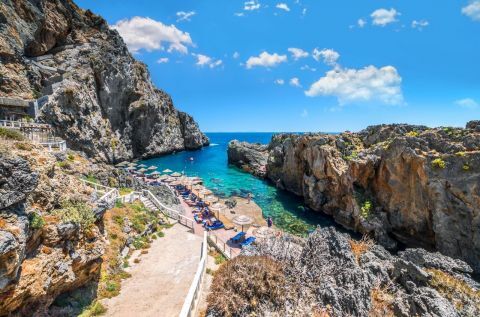
The monastery is located 23 kilometres from the town of Rethymno, on the southern coast of Crete, nearby the idyllic Preveli Beach.
Its main church is a cathedral standing in the centre of the courtyard. It has a wonderful façade which constitutes a fine example of the Cretan Renaissance architecture.
The church is situated in the village of Lambini which is 27 kilometres south of the town of Rethymno.
It is a cross-shaped church with a cupola and its interior is entirely decorated with wonderful frescoes which date from the 12th and 14th century.
| The
Church of Panagia Thronou |
|
The church is located in the village of Thronos which is part of the district of Amari, south-east of Rethymno.
It is dedicated to the Assumption of the Virgin and dates from the 14th century.
It was built on the site of an early Christian basilica from the 6th century, of which a part of the beautiful mosaic floor has been excavated, and is exhibited in the church.
The fine frescoes embellishing the walls of Panagia Thronou are worth seeing.
| The Church of
Agios Eftychios |
|
Located nearby the village of Chromonastiri, 12 kilometres south-east of the town of Rethymno, the church is single-aisled, cross-shaped and with a dome.
It is dedicated to Agios Eftychios, and its interior walls are completely covered with superb frescoes that are dated to the 11th century. |
 |
It is a church with two aisles, dedicated to the Holy Virgin and to Christ the Saviour. The interior walls of the church are covered with worth-seeing frescoes dated from the 14th century, while its belfry was erected in 1627.
The Early Christian Basilica of Goulediana.
This is a three-aisled basilica which was discovered at the site of Onythe, south-east from the village of Goulediana and 18 kilometres south-east of Rethymno Town.
The church has been dated to the 6th-7th century and has some astonishing rich mosaic ornaments.
| The
Early Christian Basilica of Goulediana |
|
This is a three-aisled basilica which was discovered at the site of Onythe, south-east
from the village of Goulediana and 18 kilometres south-east of Rethymno Town.
The church has been dated to the 6th-7th century and has astonishing rich mosaic
ornaments.
| The
Church of Agios Ioannis |
|
This church stands in the village of Gerakaki, 41 kilometres south-east of the town of Rethymno. It is dated back to the 13th century and is dedicated to Agios Ioannis the Theologist. It has a single aisle and a tiled roof.
This church was built in different stages, which explains the more recent aspect of its domed narthex.
The frescoes that adorn the interior walls of the church are particularly interesting and beautiful
This basilica stands north of the village of Panormos, about 30 kilometres east of Rethymno Town and is the largest early Christian church of Crete. It was excavated in 1948 and dates back to the 5th century. The basilica has a wooden roof and is dedicated to Agia Sofia (Saint Sophie).
|